The History of Muckross Abbey, Killarney
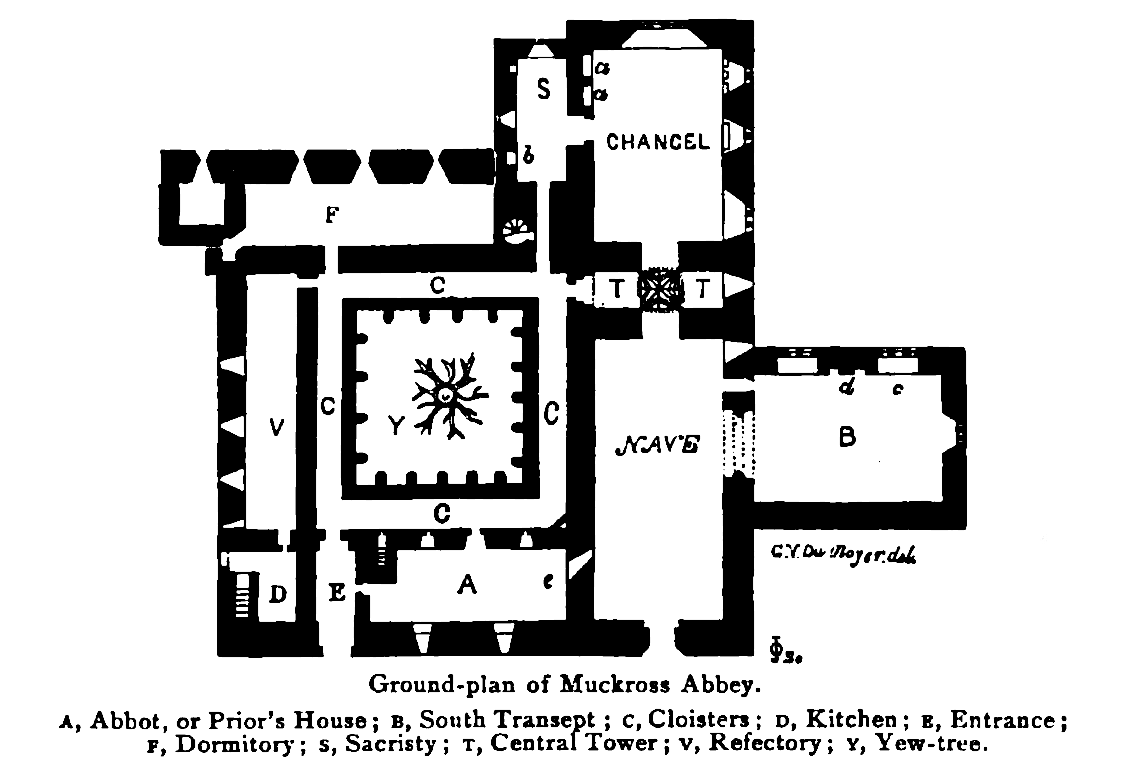
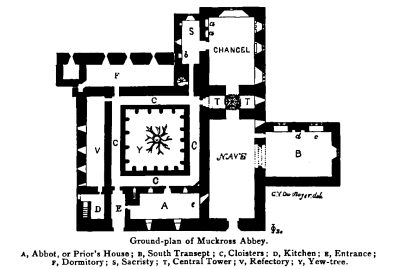
Walk into the cloister at Muckross Abbey and the building stops being a ruin for a moment. The nave is roofless and the sky is where the ceiling should be, but the cloister is vaulted, intact, and almost completely filled by a single enormous yew tree whose branches reach the tops of the arches on all four sides. People stand in there and go quiet.
The tree is the reason most visitors remember the place, and it is also where the abbey's history and its folklore are hardest to separate. This is an attempt to do both: what is actually known about the friary founded here in the fifteenth century, and what has been told about it since.
The yew tree in the cloister
Start with the arithmetic, because it undercuts the story everyone is told.
The friary was founded in 1448. The romantic version says the friars planted the yew when they built the cloister, or else built the cloister around a tree already growing there. Either way the tree would be close to six hundred years old.
The tree experts do not agree. Aubrey Fennell, who surveyed it for Heritage Trees of Ireland, put it at at least 350 years old, and the working estimate you will see quoted is 350 to 400 years. That places its germination somewhere in the seventeenth century - after the friars were driven out, not when they arrived. Yews are notoriously difficult to date, because they grow at wildly different rates and hollow out as they age, so nobody will state this flatly. But on the best available reading, the tree is younger than the walls around it, and the cloister was not built to fit it.
That does not make it a young tree. Charles Smith saw it in the 1750s and described it as one of the tallest yews he had come across, its branches spreading like a great umbrella over the niches of the cloister. It was already the abbey's landmark two and a half centuries ago.
There are several traditions about where it came from. One says it was lifted as a sapling from the monastic island of Innisfallen out on Lough Leane and planted in the heart of the abbey. Another says it grew over the grave of a monk who had been away a hundred years and came back to die. A third says a miraculous image of the Virgin lies buried beneath it.
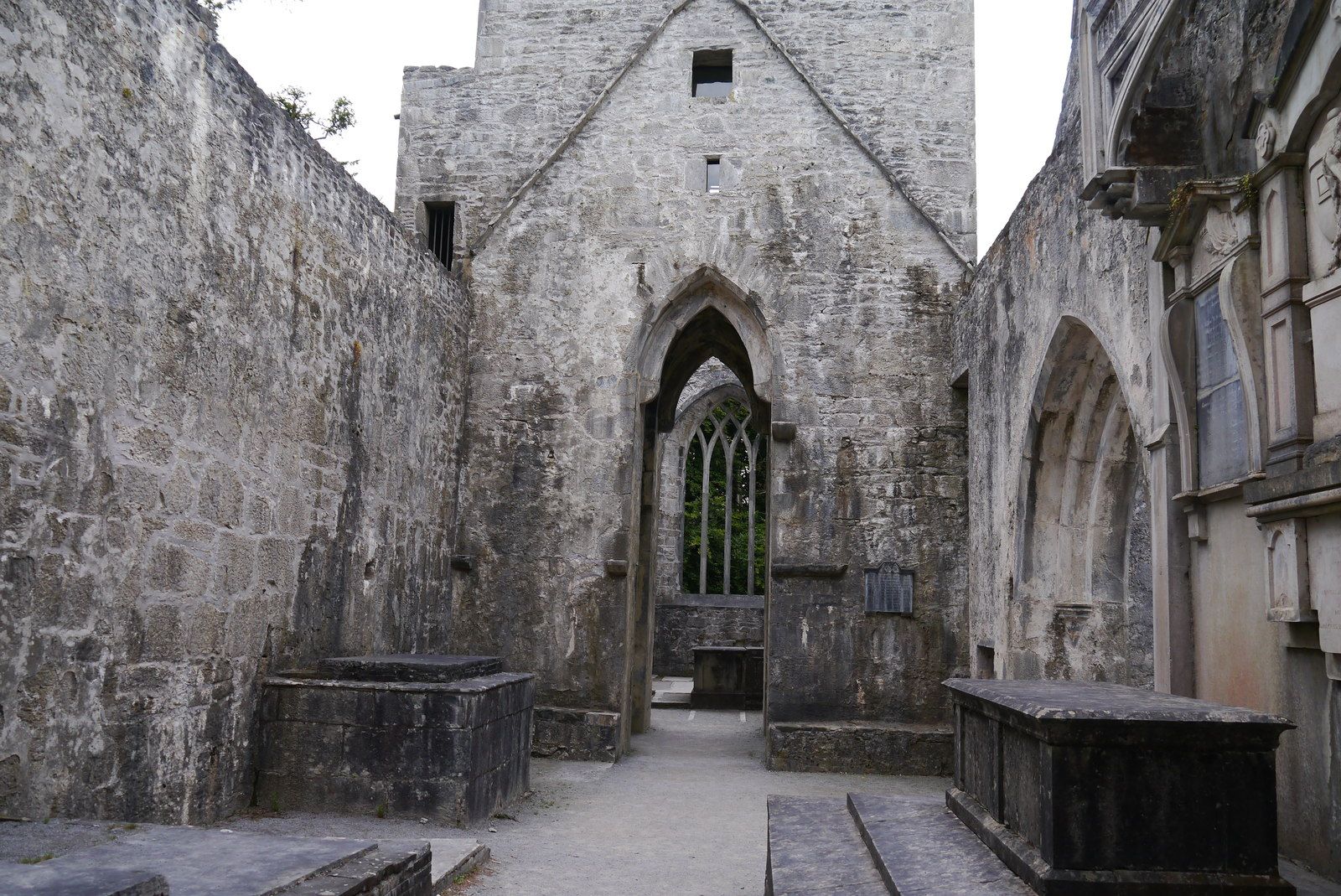
The legend of the bleeding yew
And then the one people actually repeat: cut the tree and it bleeds, and you will be dead within the year.
Fennell records the version in which a soldier hacked off a small branch, saw it drip blood, and dropped dead where he stood. The tree was widely held to be haunted, and the prohibition on damaging it was taken seriously enough to be a real deterrent rather than a story for tourists.
It is worth knowing that yew sap genuinely does run red. A cut yew branch weeping something that looks unmistakably like blood is not a tall tale, it is botany, and it is the sort of observation that a legend builds itself around rather than the sort that a legend invents. Every part of the yew except the flesh of the berry is also seriously poisonous, which has never hurt the tree's reputation for menace.
The warning has done its job, in any case. The tree is unharmed, and the sign asking you not to touch it is doing less work than six hundred years of people being told what happens if they do.
Irrelagh: the founding of the friary
The abbey was founded in 1448 for the Observantine Franciscans, under the patronage of Donal McCarthy Mór, the Gaelic chieftain whose family held this end of Kerry. The Observantines were the reforming, stricter wing of the Franciscan order, and Muckross was part of a wave of Observantine foundations across Gaelic Ireland in the fifteenth century.
It was not called Muckross Abbey then. Its name was Irrelagh, from the Irish Oirbhealach, and that is the name you will meet in the earliest records. It is also, strictly, not an abbey at all: Franciscans live in friaries, not abbeys, and the Office of Public Works still lists the site as Muckross Franciscan Friary. The name Muckross Abbey is what stuck, and there is no point fighting it.
One date needs a warning label. The Annals of the Four Masters give 1340 for the foundation, and that date has been copied into a great many books, plaques and websites. It is wrong. The friary belongs to the 1440s. If you find a source confidently telling you the abbey is fourteenth-century, you have found a source working from the Four Masters without checking.
Dissolution, return, and Cromwell
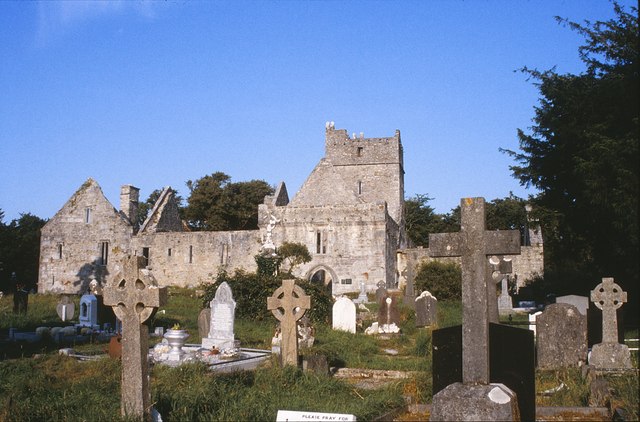
The friary outlasted the Reformation by a remarkably long margin. Henry VIII's dissolution of the monasteries reached Ireland in 1540, but the friars simply stayed, and were still at Muckross in 1589. During the Desmond Rebellions the buildings were sacked by English forces under Elizabeth I, and in 1595 the property was granted away to a Captain Robert Collum.
The Franciscans kept coming back. They returned several times in the early seventeenth century, and in 1626 Friar Thaddeus Holen restored the buildings and the community resumed.
It ended in 1652. Cromwellian forces under General Edmund Ludlow took the roof off, which was the standard and highly effective method of making a building permanently uninhabitable without the trouble of demolishing it. Some of the friars were killed. The survivors scattered, several of them as far as France. The abbey has stood open to the Kerry weather ever since, which is why the cloister vault survives and almost nothing above it does.
The burial ground
For most of its post-Cromwellian life, the abbey's real function was as a graveyard, and this is the part of its history with the deepest documentation.
The McCarthy Mór chieftains were buried here. So were the Four Kerry Poets, the last major voices of the Gaelic literary order: Séafraidh Ó Donnchadha of the Glens (c.1620-1678), Aodhagán Ó Rathaille (c.1670-1726) and Eoghan Rua Ó Súilleabháin (1748-1784) lie within the abbey, and Piaras Feiritéar, the poet and 1641 rebel executed by the English at Killarney in 1653, is buried in the ground just outside. There is a real weight to that: the abbey holds the graves of the poets who wrote the elegies for the Gaelic world that the same century destroyed.
But the ordinary burials are what visitors kept writing about, and they wrote about them with something close to horror.
1760. Lord Chief Baron Edward Willes found the place remarkable for the sheer quantity of skulls and human bones piled up in it. Edward Herbert, whose family held the land, advised him not to go in at all. Burials were shallow and often coffinless, and the fear of disease was real.
1796-7. The French traveller De Latocnaye recorded how the ground was organised, and it was organised very precisely. Pilgrims performed "rounds", walking circuits of the buildings while reciting prayers. Burials were confined to the south and east of the church. Unbaptised children, soldiers and strangers were buried apart, on the west. The north side was the Devil's side, and nobody was put there.
He also witnessed a street fight in Killarney between a dead woman's husband and her brother, over whether she would be buried at Muckross or at Aghadoe. A Mr Herbert, sitting as a magistrate, broke it up and ruled for the husband. Keening women wailed throughout.
1805. John Carr simply warned tourists not to go in.
1807. Isaac Weld reported that scarcely a day passed without a burial, with bodies carried twenty miles over the mountains to get here. Keeners were hired, and Weld noted the going rate with some dryness: the women with the best lungs and the liveliest imagination earned the most.
1836. John Barrow recorded the price of a grave. Ten pence, plus the permission of the Herbert caretaker, plus proof that your family had been buried here before.
1840s. Mr and Mrs S.C. Hall noted that priests seldom attended the funerals of the poor.
1915. J. Stevenson watched the funeral of a ninety-six-year-old woman carried fourteen miles from the Upper Lake. A priest walked in front reading the service. The men wore black streamers on their hats, the women ate lunch behind the abbey, and the exact spot for the grave was argued out on the day. There was no keening at all.
Read those accounts in order and you are watching something change. Keening had been condemned by the Synod of Tuam in 1631 and by later synods, and it died out at the end of the nineteenth century. Across the century and a half from Willes to Stevenson, the folk religion of the wake and the keen gives way to orthodox clerical Catholicism, and the Famine sits in the middle of it. The graveyard at Muckross is one of the better-documented places to watch that happen.
The burials never stopped. A formal register was established in 1880, the first entry on 30 April being a one-year-old child, Patrick Mahony of Derrycunihy. In July that year there was an inquiry into closing the ground, pushed by the younger Henry Arthur Herbert; instead it was enlarged in 1881. The index to the burial ground from 1880 to 2001 is on microfilm at the Muckross House Research Library, and the graveyard is still in use by local families today. If you visit, that is worth remembering before you photograph a headstone.
The Herberts, and the ivy that is not as old as it looks
The abbey stood on Herbert land, part of the Muckross estate, and the family's care of it was a mixture of restoration, neglect and stage management.
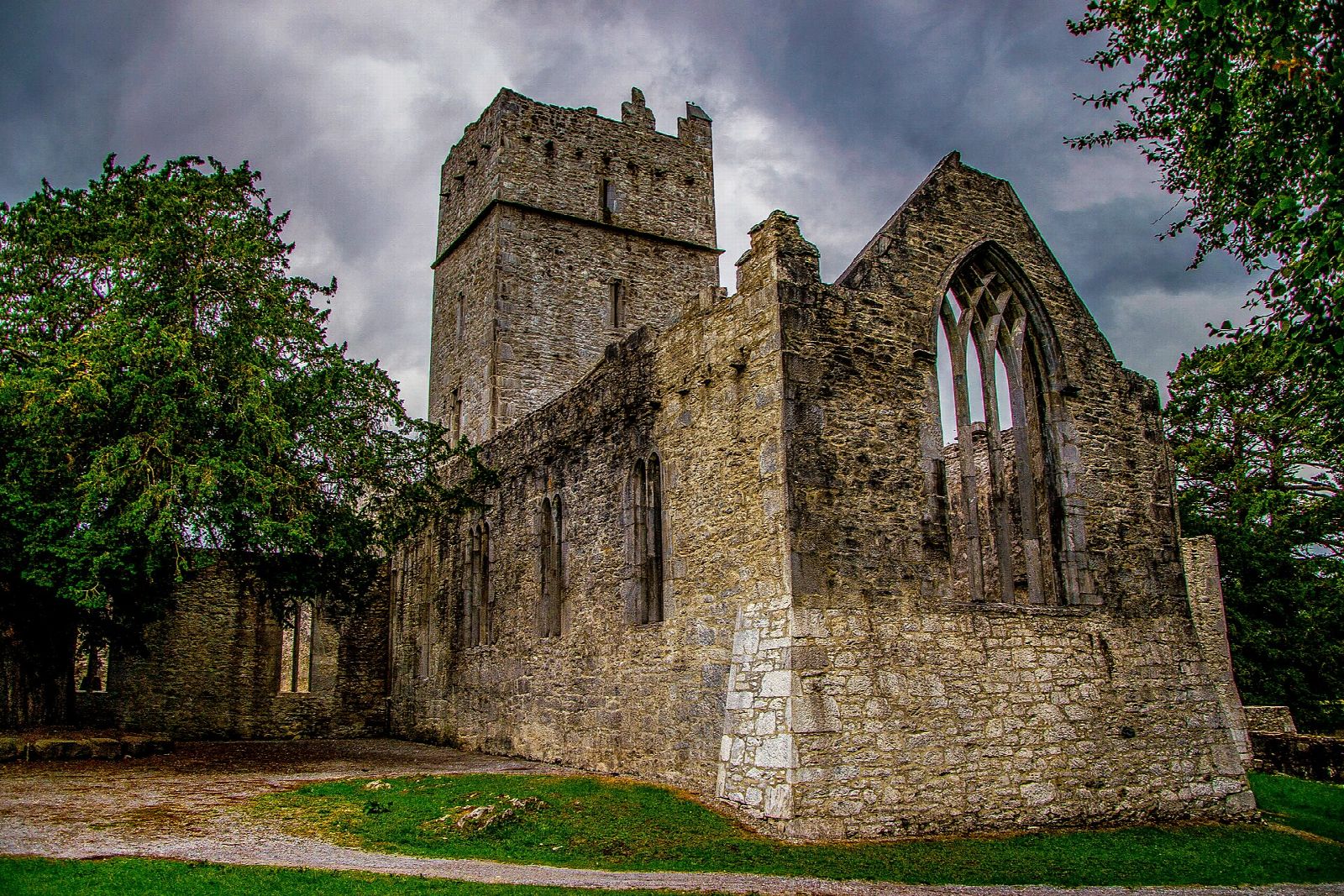
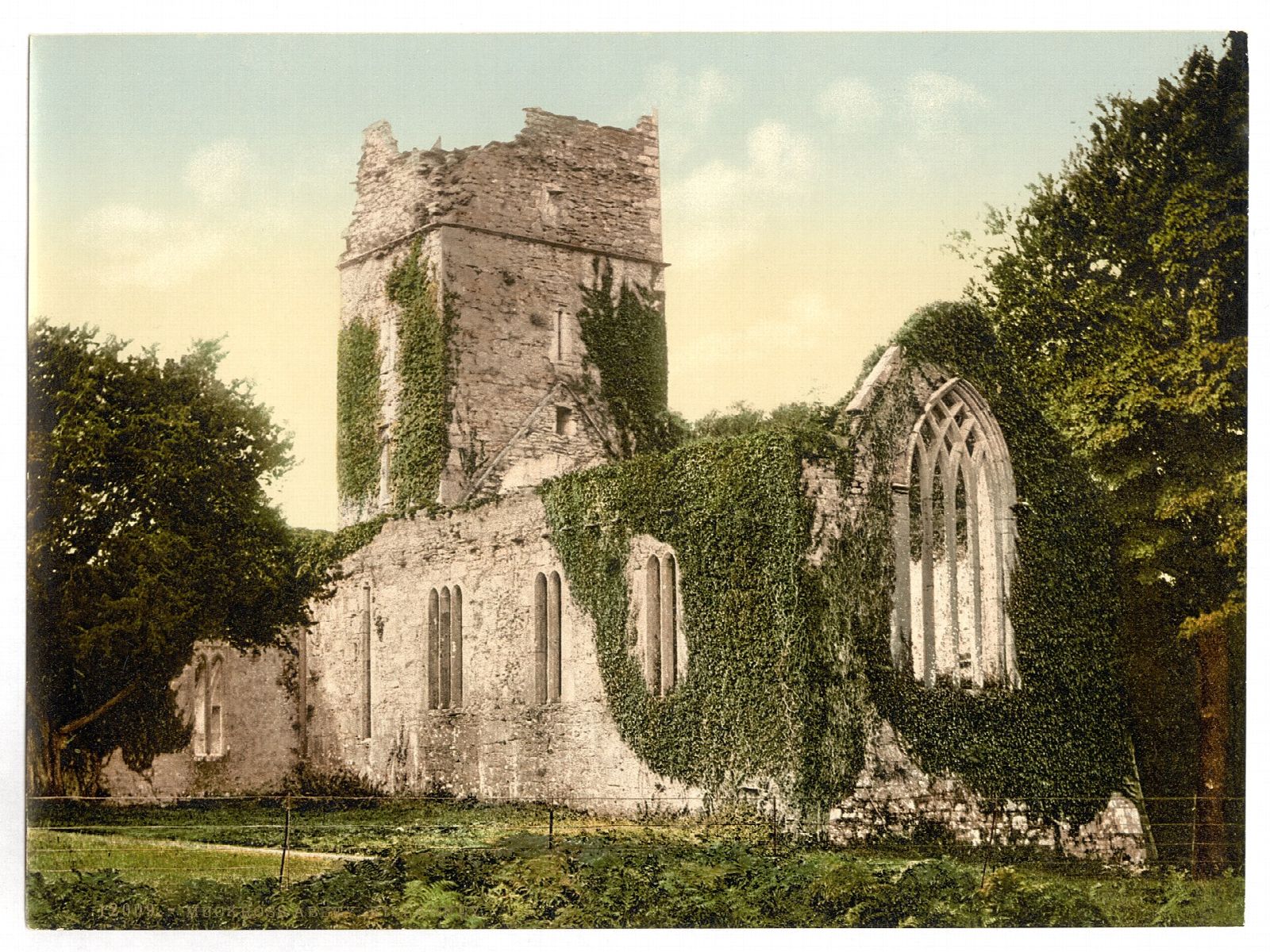
The stage management is the striking part. In 1844 the physician and travel writer James Johnson recorded that Mr Herbert had rebuilt a section of the ruin and then covered it with ivy to conceal the brickwork. The picturesque, ivy-draped ruin that Victorian tourists came to sketch was partly a Victorian production, with the ivy doing the specific job of hiding where the repairs were.
By 1853 the antiquarian Rowan noted that Herbert's "attentive custode", a Mr Gorham, was keeping the vegetation in check. In 1857 Colonel Henry Arthur Herbert told the Kerry Evening Post that he had found the burial ground in a disgraceful state when he inherited, and had appointed his gatekeeper as caretaker, letting the man keep the burial fees in exchange for maintaining the place. He explained that he could not extend the ground even if he wanted to: bog on one side, bare rock on two others, and his own demesne on the fourth. A small extension for families with rights beneath the tower was blessed by Bishop Moriarty in 1858.
Ghosts, hermits and the Brown Man
Muckross Abbey has a reputation as the most haunted place in Killarney, and it has earned about half of it.
John Drake is the story that holds up. Some time in the middle of the eighteenth century, when the abbey stood empty, a man of that name moved into it and lived there. He slept in the recess of a fireplace on a bed made from old coffin boards, and blocked the nearby window against the wind with earth and rubbish. He was said to be under forty, refined, scholarly-looking. He never told anyone where he had come from or what he was doing, and local people treated him with a mixture of curiosity and respect. Then he left, as abruptly as he had arrived. The bed was unslept in and everything else was gone. Some years later a young woman, reportedly a foreigner, came to Killarney looking for him, went to the abbey, and was seen weeping at his fireside. Neither of them was heard of again.
The Brown Man is the story you will see on every ghost-tour listing, and it needs a caveat. A newly married woman goes looking for her husband at night and finds him crouched over a freshly dug corpse, feeding on it. It is genuinely striking, and it is an Irish tale of the undead published decades before Dracula.
It is not, however, local folklore about this abbey. The story is Gerald Griffin's, published in his 1827 collection Holland-Tide; or, Munster Popular Tales - and it is frequently misattributed to Thomas Crofton Croker, whose Fairy Legends and Traditions of the South of Ireland came out around the same time. The association with Muckross Abbey does not appear to predate Griffin's book. In other words, a piece of literary fiction has attached itself to a real ruin and been retold as that ruin's haunting for two hundred years. That is a more interesting fact than the ghost.
The rest of the abbey's supernatural reputation is the yew: the bleeding branch, the buried Virgin, the monk's grave. Even the sceptical version of that has some force. This is a roofless building full of graves, with a very old and very dark tree filling its one intact room, and it does not need help.
Royalty, ivy cuttings and the souvenir trade
The abbey was on every Victorian sightseeing circuit in Killarney, reached by boat and carriage as part of a day that also took in Ross Castle and Innisfallen.
Queen Victoria came on the morning of 29 August 1861, on her way out of Killarney, before departing at noon. A lady of her suite described a very quiet visit with hardly any of the party present, everyone enchanted, wandering the ruin gathering ferns and leaves. The Queen, the account adds, was to have ivy from the abbey. The most photographed monarch in the world took cuttings home like any other tourist.
The Prince and Princess of Wales followed in 1885 and were photographed at the abbey by Chancellor and by Lafayette of Dublin. An engraving titled The Princess of Wales at Muckross Abbey ran in The Graphic on 2 May 1885.
The abbey was also a commercial image. It was one of the stock scenes inlaid into Killarney's famous arbutus-wood souvenir furniture, alongside Ross Castle, Innisfallen and Aghadoe, and it appeared on silver brooches sold to visitors.
And there was at least one man making a direct living from it. A French visitor in 1887 recorded an old man who charged tourists for recounting the abbey's history - a freelance guide, working the ruin without anybody's permission. The same account notes what the shillings were paying for: the upkeep of the paths, and the roof slates on Muckross House. By then the Herbert estate was bankrupt in all but name, and the great house was being kept weathertight on money collected by an old man telling stories in the graveyard.
A warning for anyone reading old sources
If you go looking in nineteenth-century material, you will hit this trap. In the Victorian period, "Muckross Abbey" frequently meant the house, not the ruin.
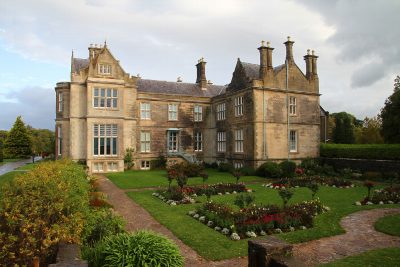
Muckross House was styled Muckross Abbey through the 1870s and beyond. Charles Edward Herbert was recorded as born at "Muckross Abbey, as Muckross House was then known" in 1879. A family game book is headed "Muckross Abbey, three and a half miles from Killarney". A piano was shipped to a guest care of Henry Arthur Herbert "of Muckross Abbey, Killarney". And when a record says that A.R. Vincent founded his Kerry cattle herd at Muckross Abbey around 1915, it means the estate, not the friary.
So a Victorian reference to someone dining, sleeping or keeping cattle at Muckross Abbey is not evidence of anything eccentric. They were at the house.
Visiting the abbey today
The abbey is a national monument in Killarney National Park, managed by the OPW as an unguided site. There is no admission charge and no gate, and it is open at all times, which is unusual for a building of this quality.
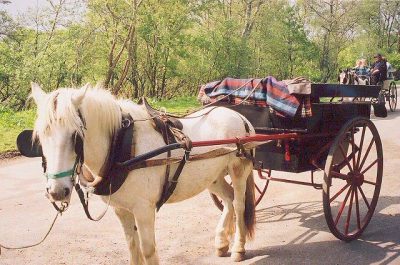
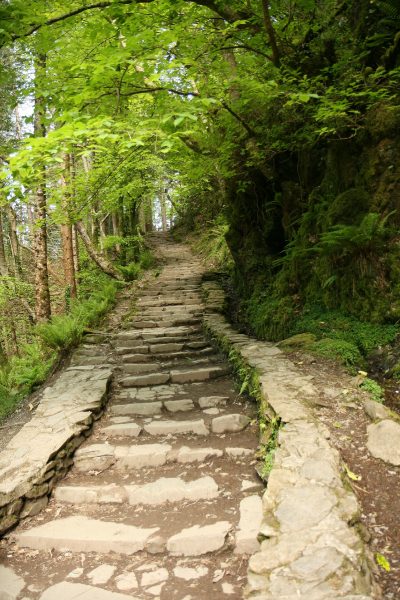
It is a ten-minute walk through the woods from the Muckross House car park, and it can also be reached on foot or by bike along the park's lakeside paths, or by jaunting car. You can wander the ground floor freely and climb the worn stairs to the dormitory and refectory above. The floors are uneven and the stairs are steep and unlit, so wear something sensible on your feet.
Go early or late. It is a genuinely atmospheric building in low light and an ordinary one in the middle of a July afternoon with four coaches in the car park.
Practical details, opening arrangements and directions are on the Muckross Abbey page, and the ruin is plotted on the Ring of Kerry map alongside Muckross House, Torc Waterfall and the rest of the park. For the story of the estate the abbey sat inside for three centuries, and the family who put the ivy on it, read the history of Muckross House and estate.