The History of Muckross House and Estate
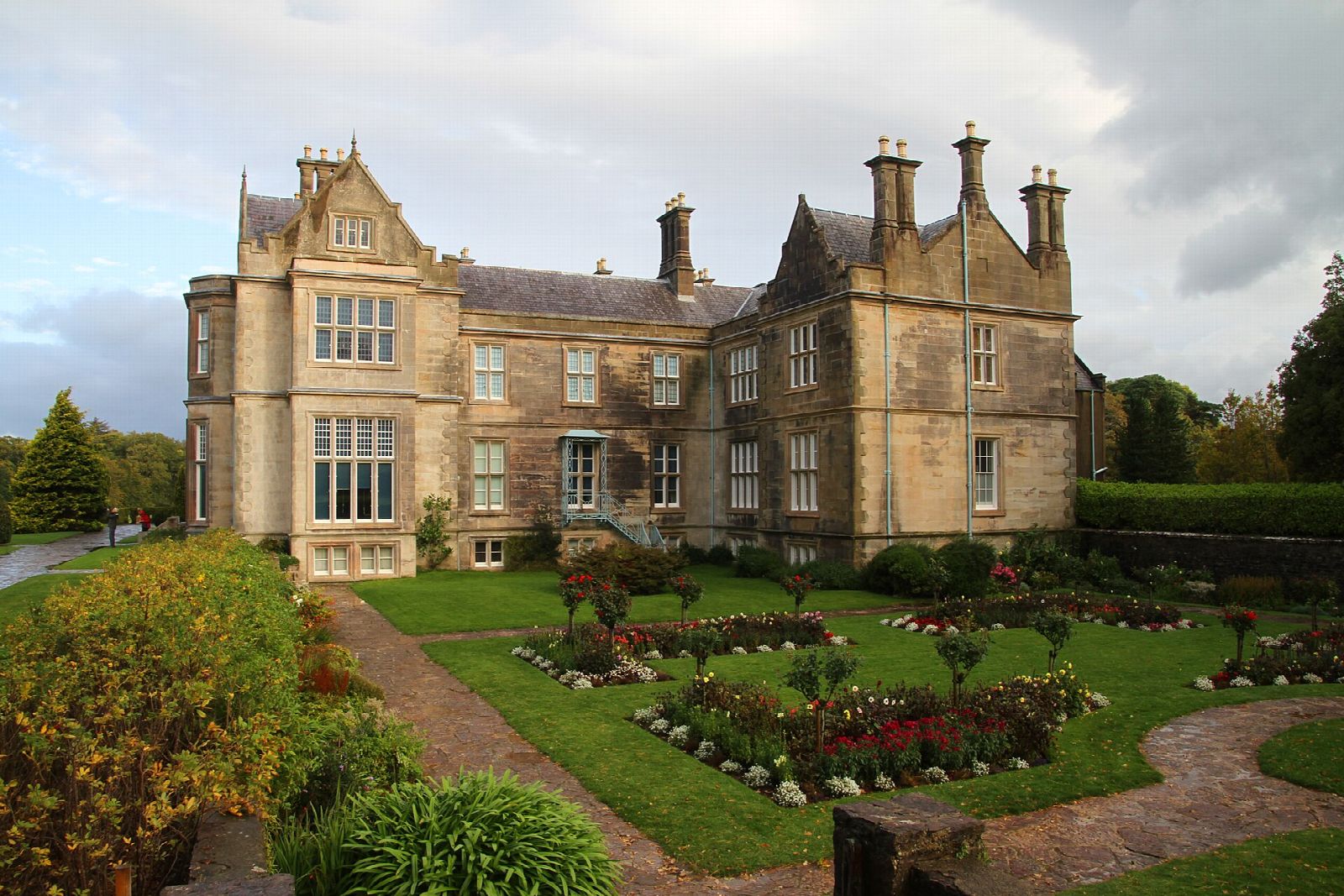
Muckross House is the great Victorian mansion of Killarney, and the standard version of its story is that the Herberts spent themselves into ruin preparing for Queen Victoria's visit in 1861, hoping for a peerage that never came.
It is a good story. It is also, at best, a third of the truth, and the documented version is better than the legend. The Herberts were at Muckross for two hundred years before the Queen arrived. They built four houses here, not one. Their money came out of a copper mine under the lake. And the estate was lost in the 1890s to a Scottish insurance company, in a slow, well-recorded collapse that had rather more to do with a divorce, a failed oil venture in Hungary and a receiver's allowance of seventy-five pounds a year than with three nights of royal hospitality.
The Herberts arrive
The family came from Wales. Thomas Herbert of Montgomery arrived at Castleisland in 1656, appointed land agent to his cousin, the third Lord Castleisland, and settled at Kilcow just west of the town. He was High Sheriff of Kerry by 1659.
His son Edward, also a High Sheriff, took a lease on the lands around Muckross from the MacCarthys, who had held this country for centuries. It is not certain whether it was that Edward or his son of the same name who first actually lived at Muckross, but the family were living here by the 1730s, and they did not own the place. They were tenants on MacCarthy land.
That changed in 1770, when the Muckross estate was left to the Herberts on the death of a MacCarthy relation. The tenants had become the landlords.
Four houses, not one
The house you can visit is the fourth Herbert house at Muckross, and the earlier three are a good corrective to any impression of unbroken grandeur.
The first stood somewhere on the Muckross peninsula, and its exact site is lost. We know what one of its residents thought of it. In 1735, Edward Herbert's wife Frances wrote to her brother, Lord Kenmare, complaining about where she was living and calling it a sad cabin. She hoped Edward would build something more suitable to receive her brother in. He appears never to have done it. Nearly thirty years later, in 1764, the visitor John Bush still put the house out on the peninsula, west-facing, with Muckross Lake and Mangerton behind it and Lough Leane in front.
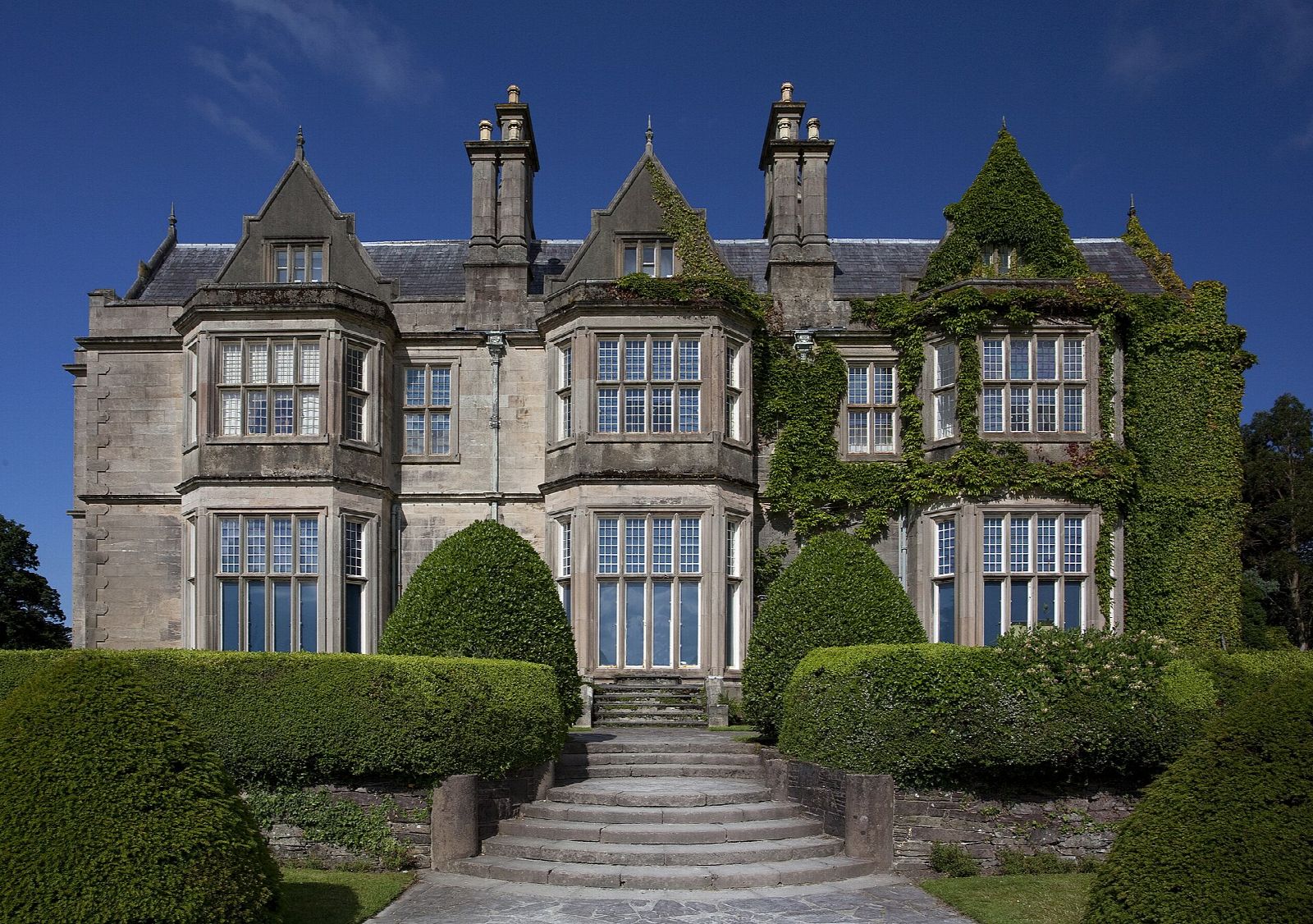
The second went up between Bush's visit in 1764 and Arthur Young's in 1776, and its foundations are still visible about 500 metres north of the present house. It was not admired either. Daniel Beaufort called it a very mean and ruinous structure in 1788, though he approved of the hall, which was flagged with the red and white marble quarried on the estate, and noted the pictures on the walls. In 1805 John Carr allowed that it was comfortable but badly situated. In 1807 Isaac Weld thought the fabric old and in evident need of an architect.
The third was Torc Cottage, properly "Turk-forest Lodge", built at the foot of Torc mountain by the Henry Arthur Herbert who was MP for Kerry from 1806 to 1813. Carr wrote that it seemed to shiver in the vast shadow of the mountain, which is the single best line anybody has written about a Kerry house.
The fourth is Muckross House.
Copper under the lake
The money that made all this possible came out of the ground.
There were copper mines on the Muckross peninsula, and in the middle of the eighteenth century they were spectacularly productive. The ore raised between 1749 and 1754 was worth around £30,000, an enormous sum at the time. Charles Smith wrote in 1756 that few mines in Europe had produced such a quantity of ore as the one lately discovered near Muckross. John Bush, in 1764, described the workings as prodigiously deep and noted that they had been driven a great way out under the lake. They were worked again between 1785 and 1818.
Thomas Herbert, who inherited in 1770 and who was the first Herbert to actually own Muckross, spent the money on improvement. Arthur Young came in 1776 and wrote it up in detail: 140 acres reclaimed from ground covered in rocks, stones, brambles and furze; bog drained; potatoes grown in lazy beds, a method Thomas was astonished to hear English writers condemn; one of the few flocks of sheep in the district. Thomas also built a three-mile road through the peninsula out to Dinis, passing a working quarry that produced green, red, white and brown marble, and the picturesque Brickeen Bridge that still links the peninsula to Brickeen Island.
Building Muckross House, 1839 to 1843
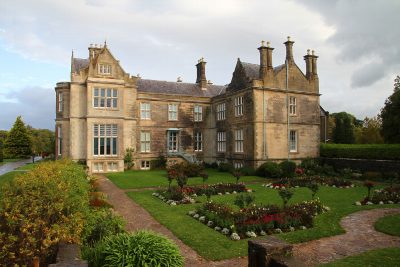
The present house was begun in 1839 and completed in 1843, for Colonel Henry Arthur Herbert (1815-1866) and his wife Mary Balfour.
The architect was the Scot William Burn, one of the busiest country-house architects of the age, and the Scottish connection went further than the drawings. Many of the craftsmen who built Muckross are believed to have been Scots who had previously worked on Whittinghame, Mary Balfour's own family home in East Lothian. That belief got some support recently in the most ordinary way imaginable: an electrician working in the attic space over the bachelors' wing found an inscription painted on a collar tie, carrying the initials of a painter from Edinburgh employed in the house in 1844.
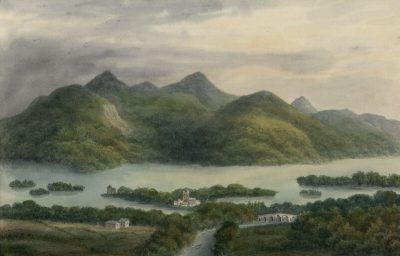
Mary Balfour Herbert is worth pausing on. She was a prolific and genuinely accomplished amateur watercolourist, and her paintings of Muckross and the lakes in the 1860s are now among the best visual records of the estate as the Herberts knew it. She was also, through her family, the aunt of Arthur Balfour, the future Prime Minister, and of Gerald Balfour, who would serve as Chief Secretary for Ireland. Her husband was MP for Kerry from 1847 until his death, and Chief Secretary for Ireland himself in 1857-58.
The Queen's visit, 1861
In 1861 it was announced that Queen Victoria would visit Killarney, dividing her stay between Killarney House, the seat of the Earl of Kenmare, and Muckross.
By tradition, the Herberts spent five years preparing. The house was extensively redecorated and refurnished. The gardens were replanted specifically with late-summer flowering shrubs and flowers, so that they would be at their best in the last week of August, and new paths and viewing points were laid out. The upholstery commissioned for the dining-room windows for the occasion is still on those windows today, taken down only for repair, which makes it one of the more remarkable survivals in the house.
The Queen arrived with Prince Albert, the Prince of Wales, Prince Alfred, and Princesses Alice and Helena. She spent the night of Monday 26 August with the Kenmares, and the following two nights at Muckross. On the morning of 29 August, before leaving at noon, she visited Muckross Abbey and took ivy cuttings home with her.
So: did the visit ruin the Herberts? The spending was real and the preparation was lavish. But the estate did not fall for another thirty-seven years, and the documented reasons for the fall are of a different kind entirely. The peerage tradition, likewise, is a tradition. What survives in the record is a barbed inversion of it: when the tenants addressed the family in 1896, with the estate already gone to the creditors, they wished the heir a bride worthy to perpetuate the name of Herbert, and called it a name higher than a peerage.
The cross that lost a letter
Colonel Herbert died on 26 February 1866, and two Celtic crosses went up in his memory. His widow Mary raised one outside the church at Cloghereen. The other was erected at Killegy graveyard, above Muckross, by the principal tenants of the estate.
The Killegy cross is the big one, standing on high ground with a view over Muckross and the mountains, and its inscription records that his tenantry erected it to mark their sense of his virtue and their grief for his loss.
His virtue. Singular. Both published transcriptions of the stone read it that way.
Local tradition holds that it was not cut that way. The word, the story goes, was carved as virtues, and the s was later removed - so that a monument raised by tenants to a landlord's many virtues was quietly edited down to the claim that he had exactly one.
We have not found the alteration documented in print, and it should be treated as tradition rather than established fact. But it is a tradition with the stone on its side: whatever the mason first cut, what is on the cross today is the singular. It is also entirely of a piece with a monument paid for by tenants of a famine-era Kerry estate, where an address of welcome could carry a compliment and a needle in the same sentence.
Colonel Herbert's son Harry, and Harry's son after him, are buried in the family vault at the same graveyard.
Harry Herbert, and the losing of Muckross
Henry Arthur Herbert the younger - Harry - inherited at twenty-six and married eighteen-year-old Emily Julia Charlotte Keane on 30 October 1866. The tenants lit a bonfire on the village green at Cloghereen to welcome them home from honeymoon. Three children were born at Muckross.
The marriage was a disaster. When the artist John Butler Yeats was commissioned to paint Emily's portrait in 1873, he recorded that the couple quarrelled like children, and delivered a verdict on his hosts that has not improved with age: he thought the Herberts barbarians, and said that they and their guests behaved like animals. Harry and Emily divorced in 1882, Harry citing Emily's adultery with a lieutenant of the Herefordshire Militia - most likely a staged accusation, which was how a divorce was obtained under the Matrimonial Causes Act of 1857.
By then the estate was mortgaged to the Standard Life Assurance Company of Scotland, and Harry went to America to repair his fortunes. What followed is a catalogue of ventures that did not come off. A company prospecting for oil in Hungary in 1881. An attempt to marry an American heiress in 1883, which failed. An attempt to remarry Emily in 1888, which also failed. Interests in paper manufacturing and potteries, some connection to Wall Street, and a plan to manufacture cotton reels on the Muckross estate.
Meanwhile the estate itself was being dismantled by degrees:
- 1887. A French visitor, the Baron de Mandat-Grancey, found Muckross an encumbered estate seized by its creditors, and reported that Henry Arthur Herbert was working as a clerk in a New York attorney's office. He also recorded how the paths and the roof slates of the house were being paid for: out of shillings collected by an old man who charged tourists for telling them the history of Muckross Abbey.
- 1889. A sale of the contents was advertised - the china, a library of nearly 3,000 volumes, the drawing-room, dining-room and best bedroom furniture - and averted at the last minute.
- December 1890. The receiver allowed Harry an income of £75 a year, out of all the rents of the estate.
- 1891. Muckross House was let for twelve months to a Captain the Hon. A. Greville. A visitor that year noted the owner was in America trying to repair his fortunes.
- 1893. Harry signed the estate over to his son, Henry Arthur Keane Herbert.
- 1896. The Herberts owed Lord Greville £40,000. A bill of sale was taken over the furniture at Muckross.
- 1897. Standard Life refused any further loans.
- 1 February 1898. Standard Life resolved to take the entire Herbert estate, house and demesne included. The transfer completed on 15 March. By 27 November the agricultural land had been sold to the former Herbert tenants.
The Herberts had been at Muckross for a hundred and sixty years. It took ten to lose it.
The 1899 auction
Muckross House and demesne went to auction in Dublin on 21 November 1899, and enormous crowds came to watch. One paper called it something of a political meeting; the press of Ireland, England and America were all there.
Bidding opened at £35,000 and moved quickly to £40,000, at which point two of the five bidders dropped out. It crawled to £49,000. A Dublin solicitor hesitantly bid £50,000, and the vendors' solicitors announced they could not let the property go at that price, bid £51,000 themselves, and adjourned the sale. A local paper, punning on the Killarney song, reported that the bidders had folded their wings and rested.
Eight days later, on 29 November, it was announced that Lord Ardilaun had bought Muckross for £60,000. Ardilaun was a member of the Guinness family and a prominent Irish Unionist, and his wife Olivia was a niece of the Henry Arthur Herbert who had built the house. The sale was called the greatest business transaction of national and historic moment in the country that century, and the next best thing to Killarney being given to the nation outright.
The relief was general and openly political. Killarney Urban District Council passed a resolution welcoming a nobleman whose public record guaranteed that local people had nothing to fear from the estate's future management. The Board of Guardians passed a similar one. Lord Kenmare wrote to say he was thankful on every ground, public and private. Gerald Balfour, then Chief Secretary and a nephew of Mary Herbert, wrote to Ardilaun that despite their many political differences he was gratified by the purchase.
Then the Ardilauns barely came. They spent very little time at Muckross, and in 1911 they sold it again.
An American wedding present, 1911
The buyer was William Bowers Bourn, a wealthy Californian. He and his wife Agnes gave Muckross to their daughter Maud and her husband Arthur Rose Vincent as a wedding present.
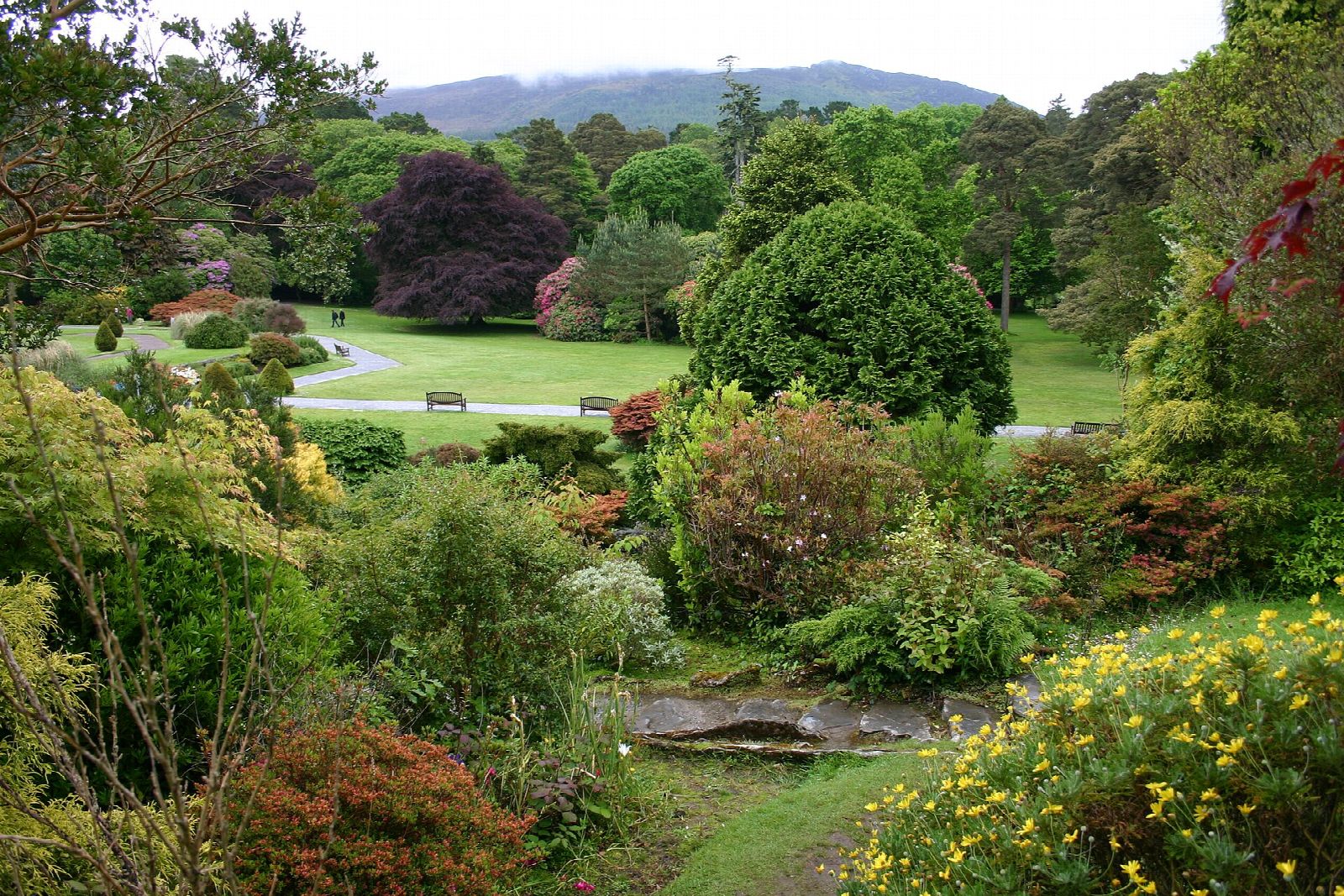
The Vincents spent heavily and spent well, and the gardens as you see them are substantially theirs. Greenhouses went up in 1911 to supply the house with grapes, nectarines and cut flowers. The sunken garden was designed by Wallace and Co. of Colchester and laid out by Cashman's of Cork in 1915. A parterre, a formal terrace, a rock garden and a stream garden followed. Between 1911 and 1932 the Vincents put very large sums into the place, and a number of the management practices Arthur Vincent introduced outlasted him on the estate.
The gift, 1932
Maud Bourn Vincent died in 1929, still young. In her memory, Arthur Vincent and his parents-in-law took the decision to hand Muckross over.
The house, the gardens and roughly 11,000 acres were presented to the Irish people as the Bourn Vincent Memorial Park, which came into being on 1 January 1933 and became Ireland's first national park - the core of what is now Killarney National Park.
Arthur Rose Vincent lived until 1956 and is buried at Killegy, on the hill above the estate he gave away. Local wit supplied two explanations for the tradition that he wanted to be buried standing up: so that he could go on looking out over Muckross, or so that nothing would fall out of his pockets.
Thirty years of an empty house
Here is the part that surprises people: the house then sat closed for three decades. The park was the gift; the mansion in the middle of it was simply shut.
It was reopened by local effort. In 1964 a voluntary committee in Killarney set out to make Muckross House a folk museum, and the enthusiasm was startling. At the public meeting called to report progress, loudspeakers had to be rigged up outside the hall for the crowd that could not get in, and it was said that practically every family in Killarney town was represented. The committee drew in help from the National Museum, the Irish Folklore Commission, An Taisce, and the staff of St Fagans in Wales and the Museum of English Rural Life at Reading.
Dr Jim Ryan, Minister for Finance, agreed to let the house open - for a trial period of four months.
The preparations were done at speed. Fifty prints of old Killarney belonging to Dr Frank M. Hilliard, who became the first chairman of the Trustees, were prepared for exhibition, along with eighty photographs from the Board of Works. The Killarney branch of the Irish Countrywomen's Association furnished a room. Seven watercolours by Mary Balfour Herbert were hung in the house she had built. The rear entrance was widened for cars, electricity was run to the basement, Dr Hilliard wrote the history pamphlet, and adult admission was set at two shillings and sixpence.
A group of local schoolgirls were taken on as the first guides. Mary Quille, Anne Maguire and Mary Cronin are named as the first three.
One detail of that summer is worth keeping. Some officials were reluctant to advertise that Queen Victoria had slept in one of the bedrooms, so it was decided to describe her room as "the guest room for important visitors". The Trustees' own account calls this an interesting reflection on the times, which is putting it gently: in 1964 the most marketable fact about the house was one nobody wanted printed.
Muckross House opened to the public on 14 June 1964, blessed by the local Administrator, with around 5,000 people present and Irish dancing on the lawns afterwards. In the sixteen weeks of that first season, 19,500 people from 48 countries came through. Forty-six per cent of them were Irish.
The committee took those figures back to Dr Ryan, who granted a ten-year lease on condition they incorporate. The Trustees of Muckross House (Killarney) were incorporated in May 1965, and Edmund "Ned" Myers was appointed the first full-time manager late that year, a post he held until his death in 1986. The craft workshops, the research library and eventually the Traditional Farms, opened in 1993, all grew out of that first committee's ambitions.
The house is run today by the National Parks and Wildlife Service in partnership with the Trustees, and it has now been open to the public for longer than the Herberts lived in it.
Visiting Muckross today
Practical detail - opening hours, admission, the guided tour of the house, the gardens, the Traditional Farms and parking - is on the Muckross House and Gardens page, and the estate is plotted on the Ring of Kerry map.
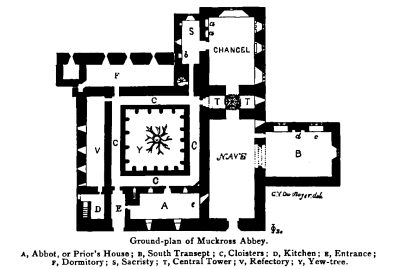
If you want to walk the history rather than read it, four places on the estate carry most of this story. Muckross Abbey is ten minutes through the woods, and has its own long history. The foundations of the second Herbert house lie a few hundred metres north of the present one. Brickeen Bridge, on Thomas Herbert's road out to Dinis, still carries walkers and cyclists. And Killegy graveyard, above the old village of Cloghereen on the N71, holds the Herbert vault, Arthur Vincent's grave, and the cross with the missing letter.